

Chronic back pain is the leading cause of disability worldwide, affecting 1 in 5 adults aged 20 to 59 years. But an analysis of randomized trials and observational studies led a panel of experts to strongly advise against the spine interventions commonly used for chronic axial and radicular low back pain treatments in a new clinical guideline.1 The panel found that the treatments offered little or no relief compared with placebos.
The review of 81 trials, published in the BMJ, found no high-certainty evidence showing nerve ablation procedures or injections of local anesthetic or steroids resulted in pain relief. Because these treatments are costly, can burden patients, and provide a small risk of harm, an international group of clinicians, research methodologists, and patients concluded that people with back pain unrelated to cancer, infection, or inflammatory arthritis should not receive them.
The review of 81 trials found no high-certainty evidence showing nerve ablation procedures or injections of local anesthetic or steroids resulted in pain relief.
Despite their lack of efficacy, the treatments have become an entrenched part of common practice. Between 1994 and 2001 in the US, there was a 271% increase in lumbar epidural steroid injections (from 553 to 2055 per 100 000 patients) and a 231% increase in facet injections (from 80 to 264 per 100,000 patients) for low back pain..2
A panel of experts has strongly advised against these commonly used spine interventions for chronic axial and radicular back pain in a new clinical guideline, citing an analysis of randomized trials and observational studies. Their review of 81 trials, published in the BMJ, found no high-certainty evidence that nerve ablation procedures or injections of local anesthetic or steroids provided pain relief, with results comparable to placebos.
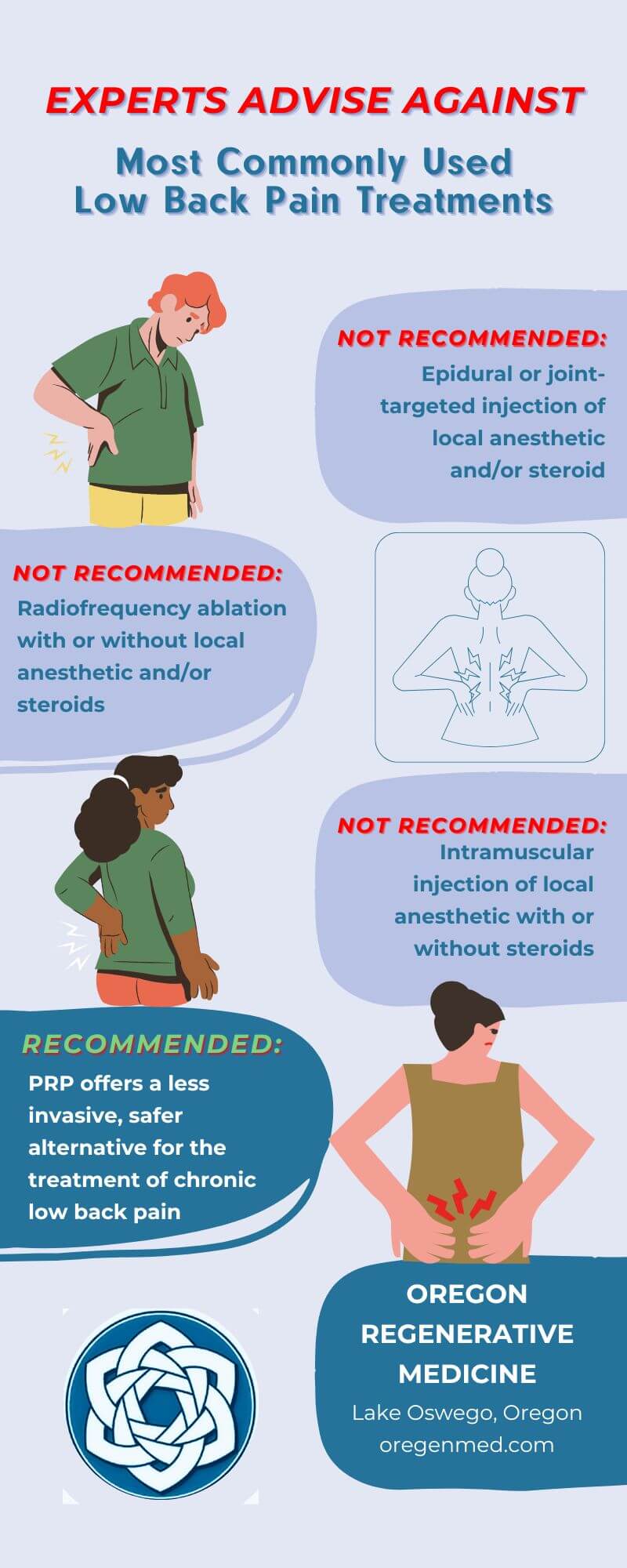
Given the ineffectiveness demonstrated by the evidence, the international group of clinicians, research methodologists, and patients concluded that these low back pain treatments should not be used for spine pain unrelated to cancer, infection, or inflammatory arthritis. An author of a linked editorial suggests that while the use of these injections may persist in the short term, healthcare systems will likely become less willing to fund them as evidence continues to show a lack of support for their widespread use. Chronic back pain affects a sizable portion of the adult population and is a leading cause of disability worldwide.
Evidence consistently demonstrates that PRP therapy offers a less invasive and safer alternative for the treatment of chronic low back pain.
Meanwhile, the PRP injection for low back pain we provide at ORM continues to gain authority. A recent systematic literature review of 13 randomized control trials (RCT) and 27 non-RCTs on the use of PRP for low back pain found that compared with the baseline values, all articles demonstrated a decrease in pain on the evaluations of 26 or 52 or 60 weeks of follow-up. When compared with the control group, the articles showed similar or superior results.3
Dr. Noel Peterson, ND, DAAPM, is the Medical Director of Oregon Regenerative Medicine, and has practiced naturopathic medicine in Lake Oswego, OR, since 1978. He specializes in natural and regenerative cellular medicine, including Prolotherapy, PRP (Platelet Rich Plasma), and Autologous Stem Cell therapy. Peterson has taught prolotherapy nationally and internationally. In 2019, the Oregon Director Association of Naturopathic Physicians (OANP) and National University of Natural Medicine (NUNM) selected Dr. Peterson to be honored with naturopathic medicine’s prestigious Living Legend Award.
Sources
- Busse J W, Genevay S, Agarwal A, Standaert C J, Carneiro K, Friedrich J et al. Commonly used interventional procedures for non-cancer chronic spine pain: a clinical practice guideline BMJ 2025; 388 :e079970 doi:10.1136/bmj-2024-079970
- Friedly J, Chan L, Deyo R. Increases in lumbosacral injections in the Medicare population: 1994 to 2001. Spine (Phila Pa 1976). 2007;32(16):1754-1760. doi:10.1097/BRS.0b013e3180b9f96e
- Machado ES, Soares FP, Vianna de Abreu E, de Souza TADC, Meves R, Grohs H, Ambach MA, Navani A, de Castro RB, Pozza DH, Caldas JMP. Systematic Review of Platelet-Rich Plasma for Low Back Pain. Biomedicines. 2023 Aug 28;11(9):2404. doi: 10.3390/biomedicines11092404. PMID: 37760845; PMCID: PMC10525951.