
About five million Americans over age 50 suffer from moderate-to-severe dry eyes, and tens of millions more have mild or episodic manifestations of dry eye disease. Dry eye disease causes eye irritation or discomfort, and can decrease functional vision, sometimes causing a dramatic deterioration in the quality of life. Americans spend hundreds of millions of dollars a year on artificial tears, immunosuppressant eye drops, surgery and even amniotic membrane grafts. None of these actually fix the problem and many are expensive.
Enter the Meibomian Gland
These treatments fail because none of them treat the primary cause of dry eyes: meibomian gland (opens in new tab) atrophy. Meibomian glands are the lipid- or oil-producing glands in the lids. Blinking stimulates oil secretion into the tears. This oil, or lipid, secretion becomes the outer layer of the tear, preventing evaporation. 86% of patients with dry eyes have some meibomian gland dysfunction.
Avoid Inferior Solutions
Available treatments include immunosuppressive eye drops, surgical implantation of tear duct plugs, and cauterization. Restasis eye drops contain cyclosporine, an immunosuppressant drug, and can cost around $250.00 for a 30-day supply; they must be used daily for years to control symptoms. Many optometrists use LipiFlow, a thermal pulsation technology that opens and clears the meibomian glands. LipiFlow does not cause regeneration, but does stimulate the remaining meibomian glands to function better. Amniotic membrane grafts have been tried but have not proven to be effective and cost well over $4000 to treat both eyes.
How We Relieve Dry Eyes
At Oregon Regenerative Medicine, we believe there has to be a better way, so we reviewed the scientific literature and distilled it into our dry-eye treatment protocol.
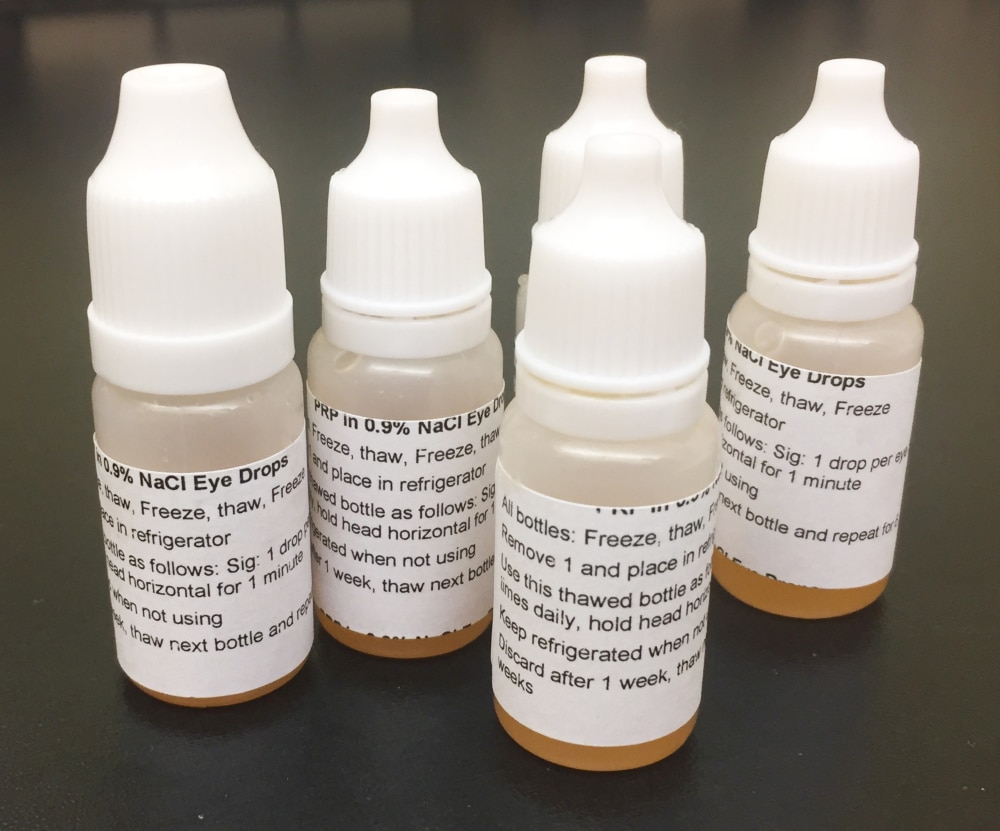
Platelet-rich plasma (PRP) (opens in new tab) is made from the patient’s own blood in our in-house lab. Published studies show that platelet-rich plasma (PRP) eye drops are absorbed into the meibomian gland and stimulate meibomian gland regeneration over time. We provide PRP eye drops after a simple blood draw and about 30 minutes of processing. Use the drops 4-6 times per day, as needed, to relieve symptoms.
PRP Eye Drops Provide Results
Initial reports from our patients who have used our protocol indicate that the PRP works better than artificial tears. Over several months, PRP eye drops provide increasingly longer-lasting relief without side effects.
Boost the Benefits
We recommend that all our dry eye patients:
1) Avoid dehydration by drinking 6 – 8 glasses of water daily
2) Avoid medications that can cause dry eye, including: antihistamines, decongestants, nearly all antidepressants, anticonvulsants, antipsychotics, anti-Parkinson’s drugs, blood pressure drugs including beta-blockers, and some forms of hormone replacement therapy.
If you or someone you know has dry eye syndrome, encourage them to consult with our regenerative medicine experts at Oregon Regenerative Medicine.
PRP eye drops articles on our website:
Dry Eye Disease: PRP results are clear (opens in new tab)
PRP Eye Drops: They gave me back my life (opens in new tab)
Alio JL, Rodriguez AE, Ferreira-Oliveira R, Wróbel-Dudzińska D, Abdelghany AA, Treatment of Dry Eye Disease with Autologous Platelet-Rich Plasma: A Prospective, Interventional, Non-Randomized Study (opens in new tab), Ophthalmol Ther. 2017 Dec;6(2):285-293. Epub 2017 Aug 8, doi: 10.1007/s40123-017-0100-z
Photo of eye: Patrick Brinksma on Unsplash